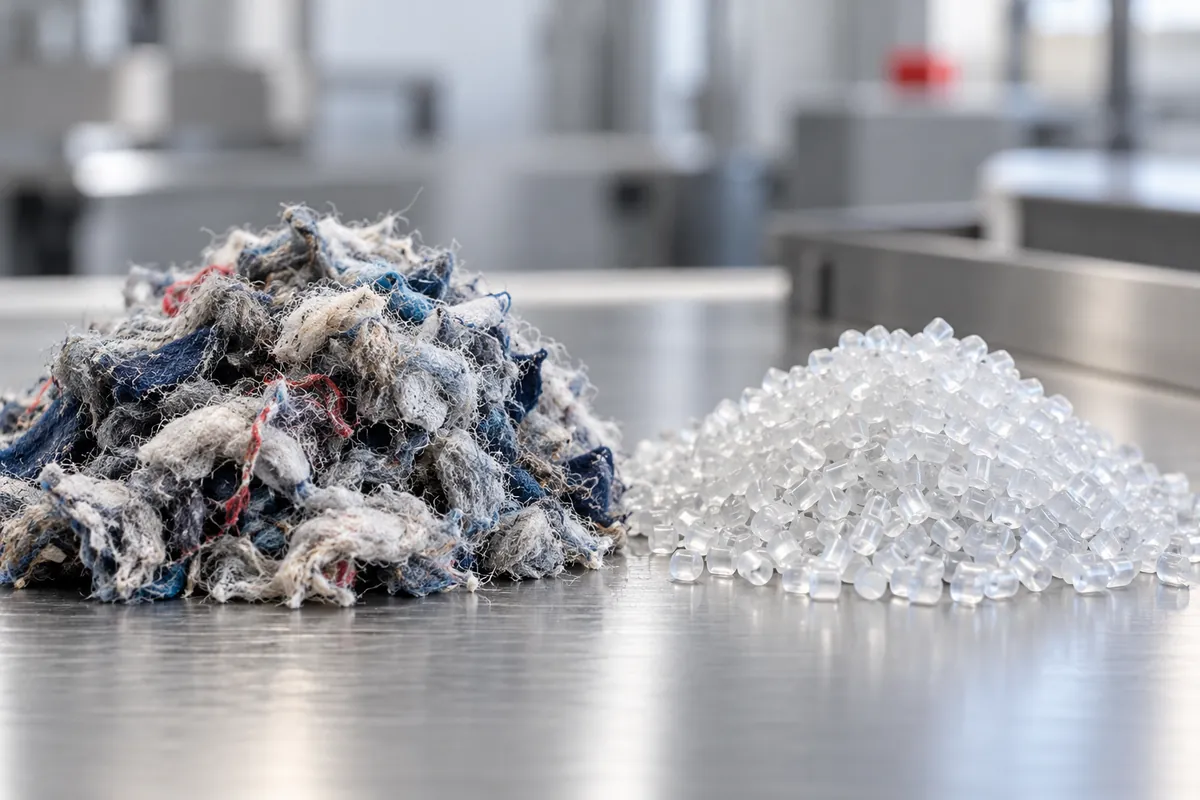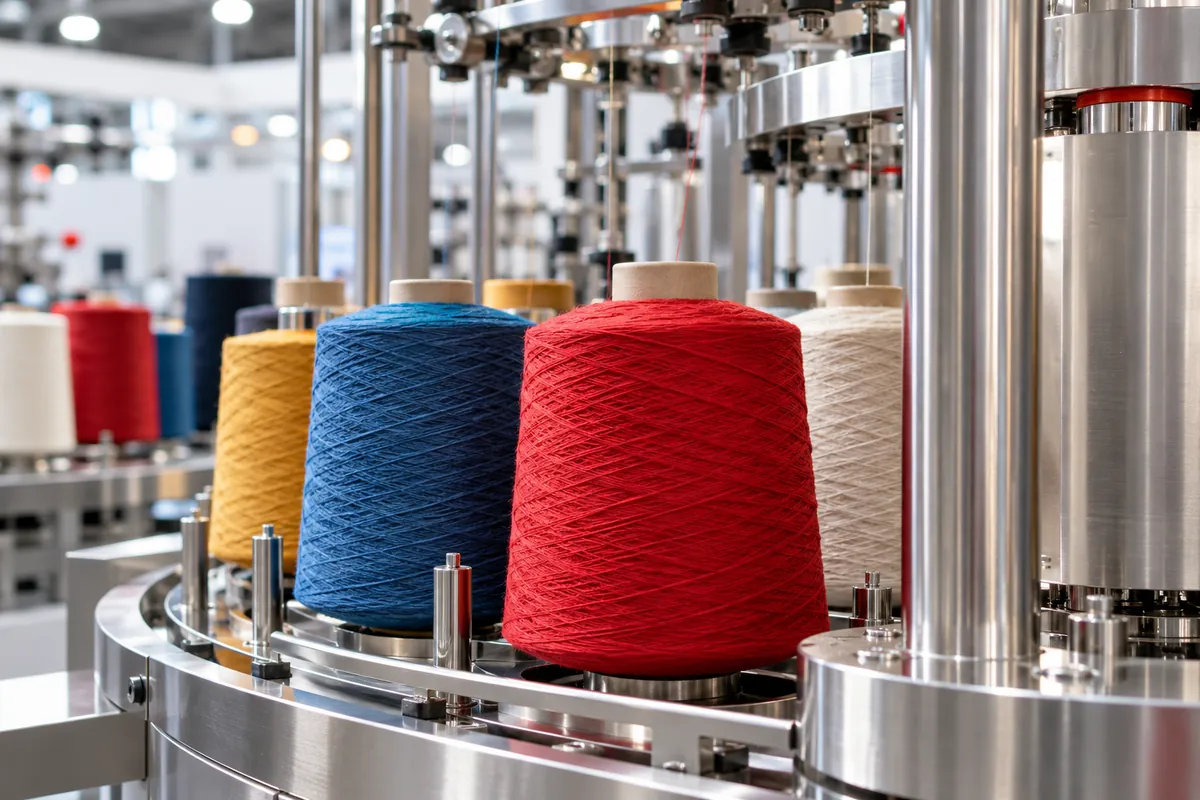

Interest in textile waste recycling is growing fast in both Europe and Türkiye. According to the European Environment Agency, the EU generated around 16 kg of textile waste per person in 2020, and only about a quarter of it was collected separately for reuse and recycling. The agency stresses that sorting and recycling capacity needs to be scaled up to keep collected textiles out of incinerators and landfills. For an investor planning that capacity, the first question is simple: what stages make up a mechanical textile recycling line, and what equipment does each one need?
The four core stages of the line
1. Collection and pre-sorting
Line quality is decided in the feedstock, before any machine runs. The source of the waste (cutting-room scraps, yarn waste, used garments) and its fibre type drive every equipment decision downstream. Pre-consumer and post-industrial waste is usually more uniform and easier to process mechanically; used clothing brings mixed fibres, colours and trims.
- Sort by fibre: keep cotton, polyester, acrylic, wool and blends in separate streams.
- Sort by colour: if the goal is undyed recycled yarn, colour groups must be built at this stage.
- Equipment: sorting tables, storage and weighing areas and, in larger plants, near-infrared (NIR) automated sorting systems.
2. Contaminant removal and cutting
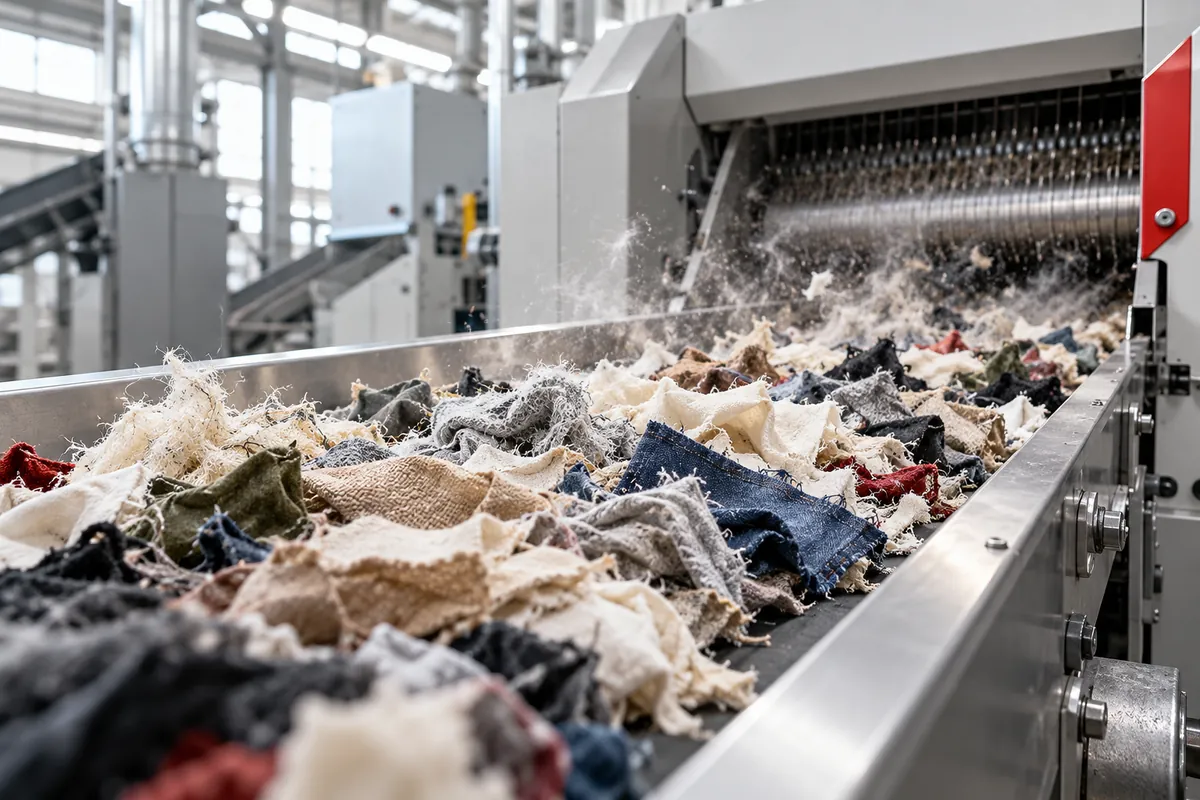
Buttons, zips, rivets, wire and hard labels damage both cutting knives and the clothing of opening machines. Manual removal before cutting and metal detection on the conveyor are therefore essential. A metal detector conveyor such as the MDB-700 is designed to catch metal-bearing pieces before they reach the cutter, but it complements source sorting rather than replacing it.
The aim of cutting is to reduce large pieces to small, uniform sizes that the opening line can take in evenly. Two main machine types are used:
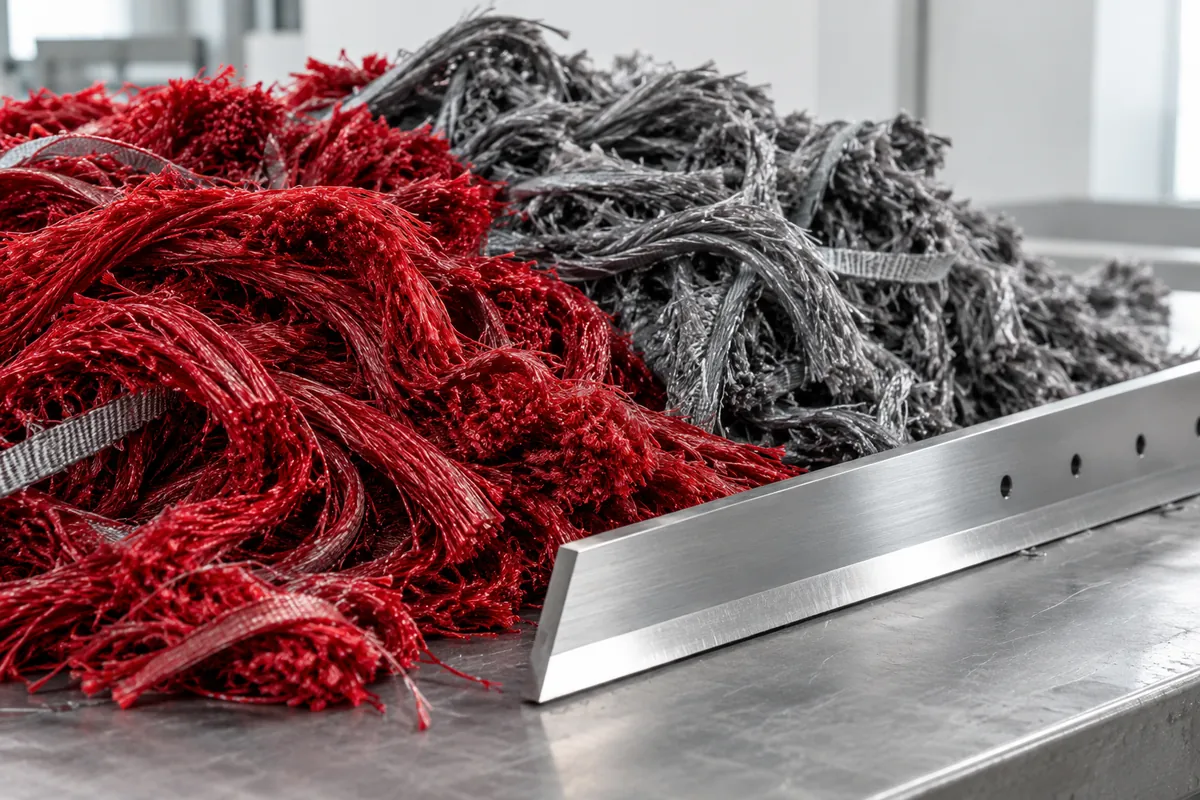
- Guillotine cutters: the knife moves up and down and cuts like scissors, giving an adjustable cut length for fabric pieces, bales and long yarn waste. The MCT60, built in Gaziantep, is one example in this class; according to the manufacturer it offers a 600 mm working width, cut lengths from 5 to 36 mm and a capacity of 1,000–3,000 kg/h.
- Rotary cutters: a rotating knife holder cuts in a continuous flow and suits continuously fed material such as nylon and polyester waste.
Feed and transfer conveyors, the metal detector and knife sharpening equipment should be sized together with the cutter. The slowest point sets the capacity of the whole line.
3. Opening (tearing) into fibre
Cut pieces are turned back into fibre on multi-stage opening or tearing machines, often called garnett lines in the trade, which use pinned cylinders. The number of stages depends on the target degree of opening and the toughness of the feedstock. Points to watch:
- Preserve fibre length as far as possible; overly aggressive opening raises short-fibre and dust content.
- Feed the cylinders evenly, which is why a consistent cut length matters.
- Use enclosed transport ducts, dust extraction and filtration, and fire protection such as spark detection.
- Add cleaning and blending units at the final stage where needed.
4. Baling, storage and dispatch
Opened fibre is compressed in hydraulic baling presses so it can be stored and shipped. Labelling bales and recording fibre type, colour and lot data is becoming more important as EU buyers expect traceability. Recycled fibre can go into nonwovens, insulation and filling materials, open-end spinning or, depending on quality, new textile products.
Planning checklist
Before building the line, run trial cuts with representative samples, define target throughput together with the shift pattern, and show electrical supply and maintenance access on the layout. For a manufacturer's step-by-step view of the same process, this guide to building a textile waste recycling line is a useful starting point.
Maintenance belongs in the investment decision too. Knife sharpness directly affects both cut quality and energy use; a dull knife drags fibres instead of cutting them cleanly and sends irregular pieces to the opening line. Sharpening intervals, a spare knife set and knife change times should therefore be settled before commissioning. Sizing the line exactly to today's volume is also risky: when feedstock grows, cutting or opening can quickly become the bottleneck. Leaving space on the layout for an extra opening stage or a second cutter avoids costly rework later.
| Stage | Core equipment | Critical check |
|---|---|---|
| Collection and sorting | Sorting tables, NIR sorter, scales | Fibre and colour uniformity |
| Contaminant removal and cutting | Metal detector conveyor, guillotine or rotary cutter, transfer conveyors | Foreign bodies, even cut length |
| Opening | Multi-stage opening/tearing line, dust extraction | Fibre length, dust and fire safety |
| Baling | Hydraulic baling press, labelling | Lot records and traceability |
Conclusion
An efficient textile recycling line is built from stages that fit together, not from individually powerful machines. Well-sorted feedstock, metal-free feeding, a consistent cut length and controlled opening determine the quality and saleability of the fibre that comes out. As extended producer responsibility schemes take effect across the EU, plants that can keep records at every link of this chain will be a step ahead.