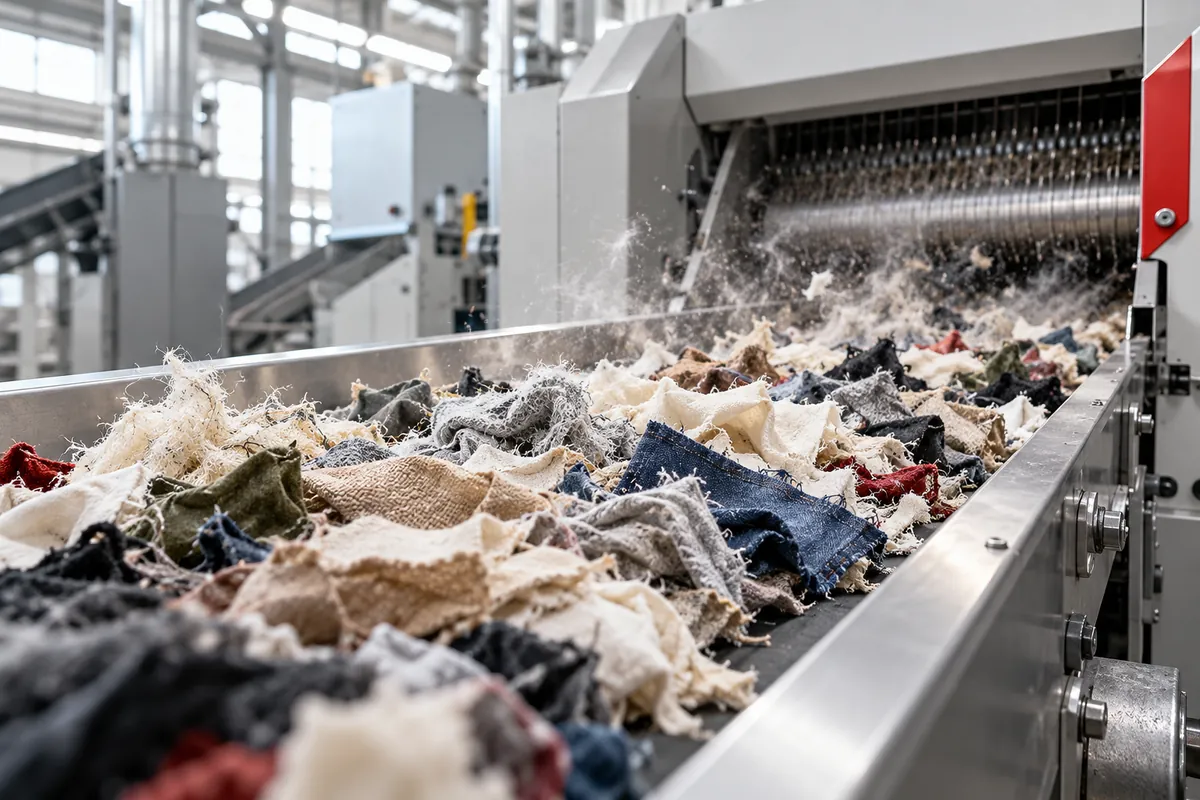

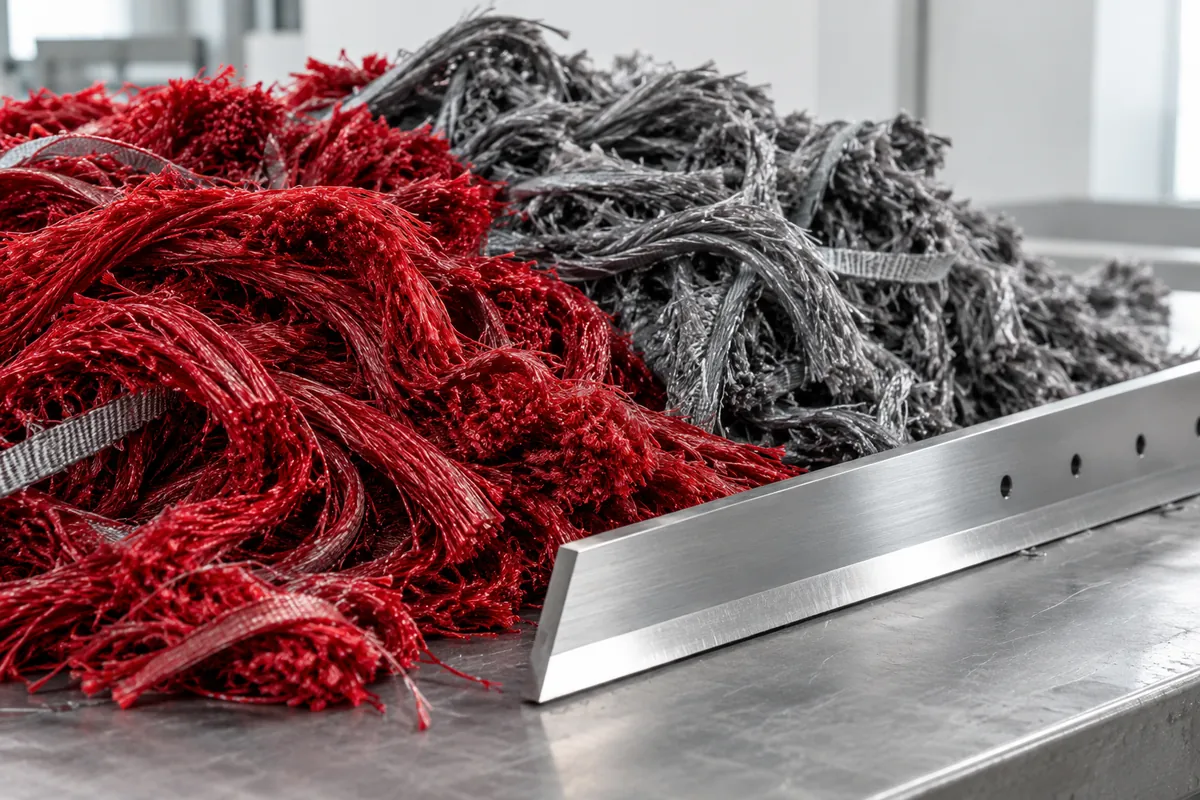
Can cotton fabric scraps and carpet yarn waste be cut on the same machine? In theory, yes; in practice the results differ widely. Carpet yarn, polyester and nylon (polyamide) yarn waste and technical textile scrap are among the toughest materials for cutting equipment because of their high strength and continuous filament structure. This article looks at the three problems seen most often on the shop floor, namely abrasion, knife wear and entanglement, and sets out practical ways to deal with them.
Why these materials are hard to cut
Garment cutting scraps are usually short, loose and irregular. Carpet yarn and synthetic yarn waste, by contrast, are long, continuous and high in tensile strength. Here is how that difference shows up at the cutter:
- High strength: as soon as the knife loses its edge, nylon and polyester filaments are crushed, stretched or pulled rather than cut.
- Continuous structure: bobbin ends and yarn tangles are long and tend to wrap around rotating parts.
- Heat sensitivity: thermoplastic fibres can soften when friction heats them; with a dull knife, melted and fused ends may appear.
- Abrasive content: carpet backing, coated technical textiles and mineral-based scrap such as glass fibre wear the knife edge faster than usual.
- Foreign bodies: bobbin tubes, metal clips and wire often arrive mixed with yarn waste.
Three core problems and how to solve them
1. Abrasion and knife wear
Once the knife edge dulls, cut quality drops, motor current rises and piece size becomes irregular. That in turn costs efficiency at the next stage, the opening line. The answer is to treat knife maintenance as part of production planning rather than a repair after failure:
- Set and record sharpening intervals for each material type.
- Keep a spare knife set to shorten downtime during changes.
- Check the clearance between the knife and the counter-knife regularly, following the manufacturer's instructions.
- Sharpen with a system that repeats the same angle and surface finish every time.
With long cutting knives, hand sharpening makes it hard to hold the angle. Using an automatic knife sharpening machine on site standardises sharpening quality and cuts the waiting time that comes with sending knives out for service.
2. Entanglement and wrapping
Long filaments wrapping around rotating parts is the most familiar problem in plants processing synthetic yarn waste. It causes stoppages as well as bearing and shaft wear. Measures that help:
- Open bobbin ends and yarn tangles before cutting, or shorten them with a pre-cut.
- Feed material in a thin, even layer, controlled by compression rollers.
- For long continuous filaments, consider guillotine-type machines that cut to a fixed length.
- Keep knives sharp; a dull knife pulls fibre instead of cutting it and makes wrapping worse.
3. Foreign bodies and dust
Metal parts in yarn waste can damage knives permanently. Source sorting, visual checks and a metal detector conveyor should work together. Cutting synthetic and mineral-based technical textiles also generates dust, which calls for an enclosed cutting chamber and extraction; with materials such as glass fibre, occupational health measures must be planned separately.
Matching the machine to the material
The right machine type depends on the form of the waste and the target cut length. Rotary cutters suit high-volume processing in a continuous flow, while guillotine machines come into their own where an adjustable, fixed cut length is needed. In the product data of Mıhçıoğlu Makine, for instance, the M-50 rotary cutter is positioned for carpet yarn, polypropylene carpet yarn, nylon parachute cord and carpet backing yarn waste, and is listed with a 500 mm working width and a capacity of 300–600 kg/h.
Technical textiles are harder to generalise about. For high-strength fibres such as para-aramid, coated fabrics or composite edge trim, the most reliable approach is a trial cut with a representative sample, observing knife life during the test.
To get meaningful results from a trial, look beyond the question "does it cut?" and check:
- the length distribution of the output and whether ends are crushed or melted;
- how motor current changes during the run;
- wrapping or build-up in the cutting chamber and on rotating parts;
- the visual condition of the knife edge at the end of the trial;
- how the cut material behaves on the opening line.
Recording these figures makes it easier both to choose the right machine and to set the first sharpening interval.
Frequently Asked Questions
Which cutting type suits nylon and polyester waste?
Rotary machines lead for high-volume continuous processing; guillotine machines are preferred for long filaments that need a fixed, adjustable cut length. The decision should be based on a trial cut with a sample.
How often should knives be sharpened?
There is no fixed interval; it depends on how abrasive the material is, the shift pattern and the level of contamination. Rising current, irregular cut length and crushed ends are signs that sharpening is overdue.
How can wrapping be reduced when cutting carpet yarn?
Pre-cutting, thin and even feeding, sharp knives and a machine that cuts long filaments to a fixed length all reduce wrapping noticeably.