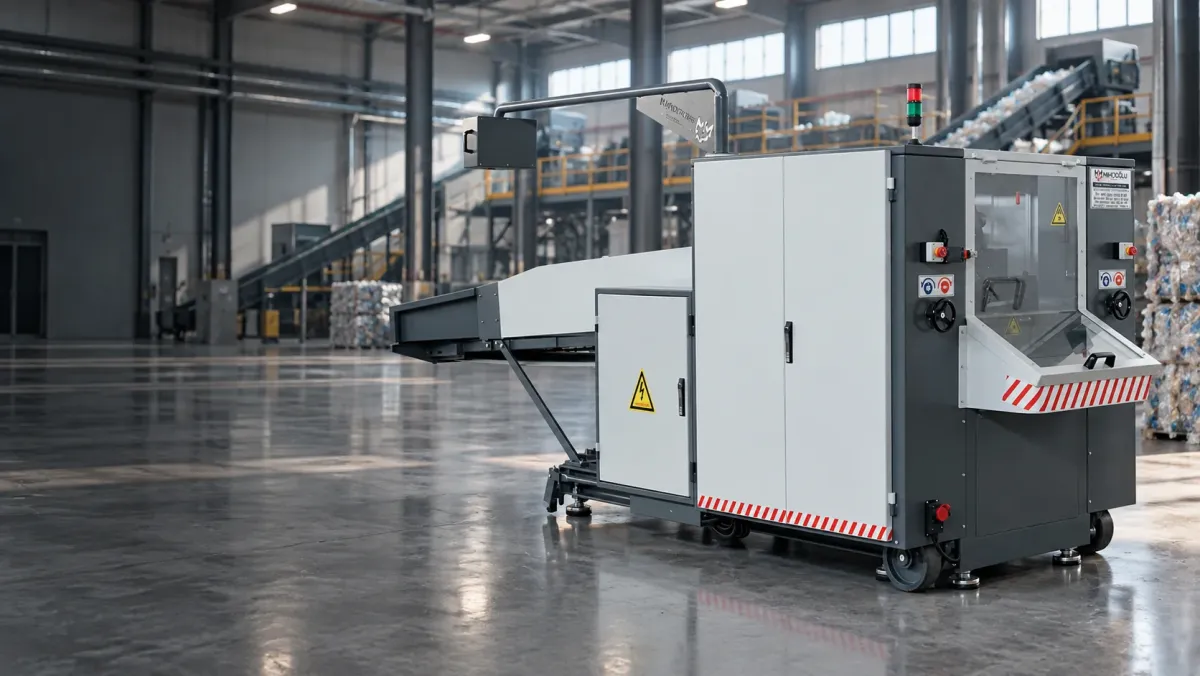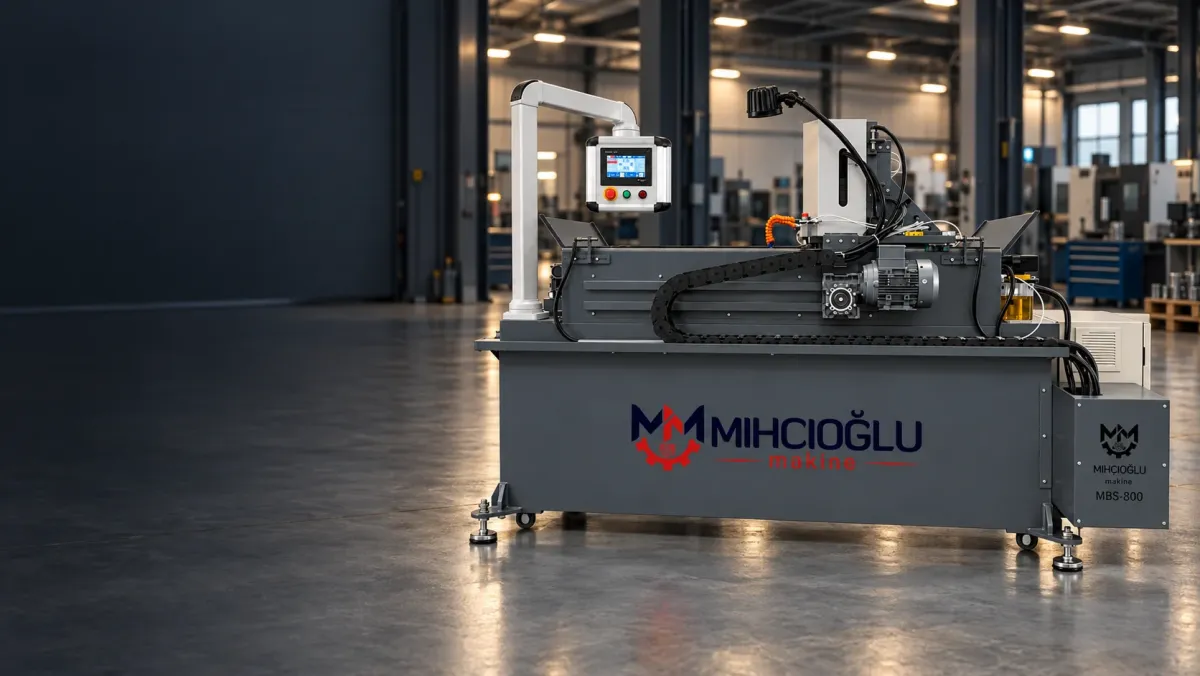

In textile and plastic recycling lines, the two technologies most often used to cut fibrous, yarn-like and flexible waste are guillotine and rotary cutting machines. Both aim to reduce waste to a size that suits the next process, but they do so with different mechanics, and that difference shows up everywhere from cut quality to the maintenance plan. This article compares the two on working principle, suitable materials, capacity range and maintenance. To give concrete figures, we use the technical data published by Mıhçıoğlu Makine, a Gaziantep-based manufacturer that builds both types; other manufacturers' machines will naturally have different values.
Working principles
Guillotine cutting
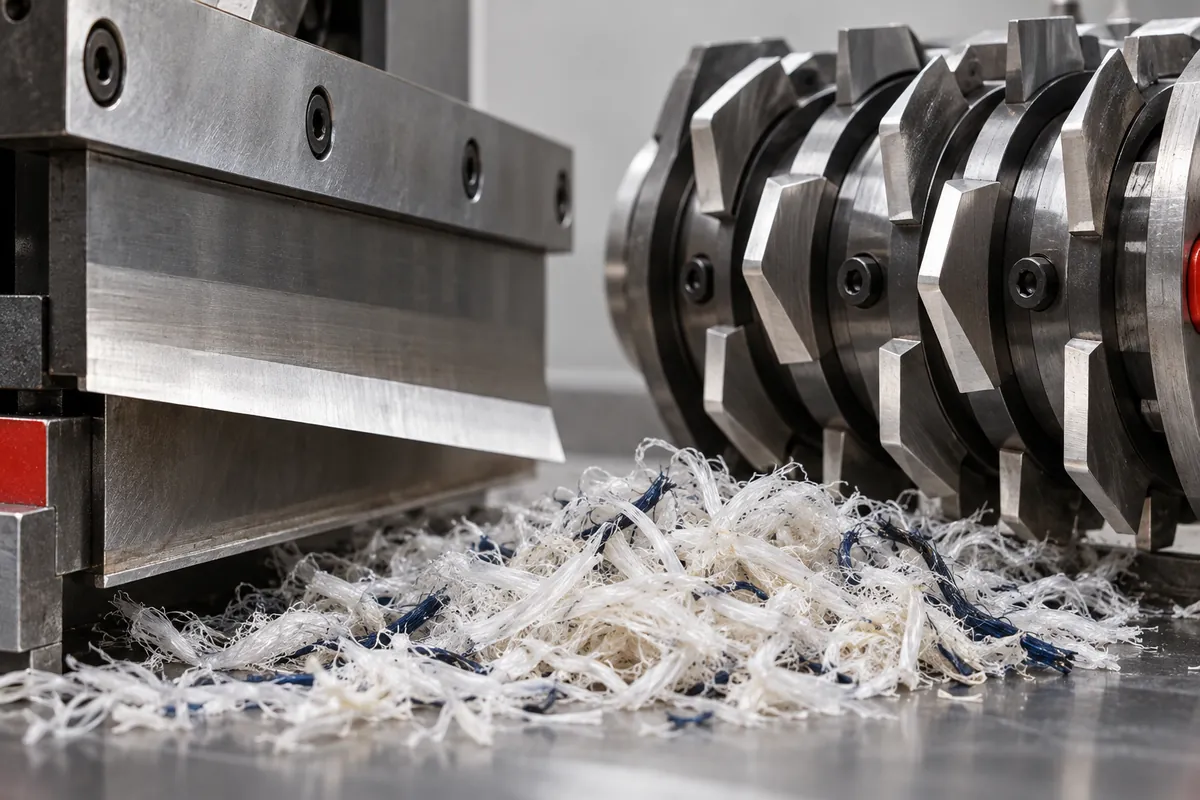
In a guillotine cutting machine, a moving blade passes a fixed counter knife in a linear, periodic stroke and cuts the material with a scissor action. The material advances on a conveyor, and the distance the belt travels between strokes defines the cut length. As a result, cut length can be set directly and precisely.
Rotary cutting
In a rotary cutting machine the knives are mounted on a rotating rotor. As the rotor turns, the knives pass the fixed blades and the cut is repeated in a continuous rotary motion. Because several cuts can take place in each revolution, rotary machines are well suited to a continuous, dense flow of material. How precisely cut length can be controlled depends on the machine design and feeding arrangement.
Comparison table
| Criterion | Guillotine cutting | Rotary cutting |
|---|---|---|
| Working principle | Linearly moving blade cuts against a fixed counter knife with a scissor action | Knives on a rotor cut continuously against fixed blades as it turns |
| Cut length control | Set directly via the feed step (e.g. 5–36 mm on the MCT60) | Depends on design and feeding |
| Suitable materials (example applications) | Polyester, fabric, acrylic, glass fibre (MCT60) | Nylon and nylon yarn waste, cord fabric yarn, polyester woven and knitted fabric, nonwovens, acrylic fibre (M-80); parachute cord, carpet yarn and PP carpet yarn waste (M-50) |
| Capacity range (example models) | 1,000–3,000 kg/h (MCT60, 600 mm working width) | 1,000–3,000 kg/h (M-80, 800 mm); 300–600 kg/h (M-50, 500 mm) |
| Installed power (example models) | 22.5 kW (MCT60) | 12.5 kW (M-80); 11.5 kW (M-50) |
| Maintenance focus | Sharpening blade and counter knife, setting the blade gap, lubricating the drive mechanism | Sharpening rotor and fixed knives, rotor blade gap, bearing checks, clearing wrapped material |
The capacity figures in the table are the ranges published by the manufacturer and vary with the material. Two machines in the same capacity band can deliver very different results on different feedstocks, so any comparison should always be made with your own waste.
Which technology for which material?
As a general rule, guillotines come to the fore where keeping cut length within a narrow range is critical. For textile waste heading to fibre opening machines, or for technical fibres where cut length directly affects product quality, a cut set by the feed step is a clear advantage.
Rotary machines are preferred in lines with a continuous, high-volume flow, where long, irregular mixes of yarn and rope waste are processed. The applications the manufacturer lists for the M-80 and M-50 show how closely this technology matches nylon and polypropylene-based yarn, cord and carpet waste. A compact rotary model can make sense for lower-volume plants or for secondary cutting within a line.
In practice the two technologies are complementary rather than competing. Some plants run both types under one roof for different waste streams.
Maintenance, operating cost and safety
With both technologies, blades are the biggest operating cost item. Dull blades reduce cut quality, increase motor load and energy consumption, and raise the risk of wrapping with fibrous material. On a guillotine, sharpening and adjustment usually focus on a single long blade and its counter knife, whereas on a rotary machine the many knives on the rotor must be sharpened evenly and the gap set consistently. In both cases, a metal-detecting infeed that keeps metal parts out of the cutting zone is one of the most effective ways to protect blade life.
On safety, both machine types require interlocked guards around the cutting zone, emergency stops and safe isolation of energy during maintenance. An important date is approaching for manufacturers and importers supplying the EU: the Machinery Regulation (EU) 2023/1230 replaces Machinery Directive 2006/42/EC and applies from 20 January 2027.
Conclusion
When choosing between guillotine and rotary cutting, the question is not "which is better" but "which suits my waste and my target product". If cut-length precision is the priority, a guillotine is the natural choice; for a continuous flow of mixed yarn waste, a rotary cutter usually fits better. Validating capacity figures with your own material, including blade and sharpening costs in the total cost of ownership and planning line integration from the start is the soundest approach. For plants abroad, a manufacturer's export product range and the technical data behind it offer a practical reference point for starting that comparison.