What Incoterms cover, and what they don't
Published by the International Chamber of Commerce (ICC), the Incoterms® rules define where delivery takes place, when risk passes from seller to buyer, and who pays for freight, insurance and customs formalities. According to the ICC's Incoterms® 2020 page, the current set contains 11 rules.
It is just as important to know what Incoterms do not cover: transfer of ownership, payment terms, warranty, installation and commissioning are all outside their scope. When buying industrial machinery, these points must be written into the sales contract separately. The contract should state the rule, the named place and the version together, for example "FOB Port of Mersin, Incoterms® 2020".
The rules fall into two groups. EXW, FCA, CPT, CIP, DAP, DPU and DDP can be used for any mode of transport. FAS, FOB, CFR and CIF are designed for sea and inland waterway transport only.
Four common rules for machinery buyers
EXW (Ex Works)
The seller makes the machine available at its own premises. Loading, export clearance, freight, insurance and import formalities all fall to the buyer. The seller is not obliged to load, which with heavy machinery raises the question of who arranges the forklift or crane. Handling export clearance in the seller's country can also be impractical for a foreign buyer, which is why many buyers find FCA, where the seller clears the goods for export, more workable.
FOB (Free On Board)
The seller loads the export-cleared machine on board the vessel nominated by the buyer at the named port of shipment, and risk passes once the goods are on board. The buyer arranges freight and insurance. FOB is for sea transport only. Where the machine is handed to the carrier at a container terminal before loading, the ICC's explanatory notes recommend FCA instead. Incoterms® 2020 also added an FCA option allowing the buyer to instruct its carrier to issue a bill of lading with an on-board notation.
CIF (Cost, Insurance and Freight)
The seller pays freight and insurance to the port of destination. But note that, as under FOB, risk passes to the buyer when the goods are loaded on board at the port of shipment. Damage during the sea voyage is therefore the buyer's risk, and the seller's insurance is there to cover it. Under Incoterms® 2020, minimum cover for CIF remains at the more limited Institute Cargo Clauses (C) level, while CIP now requires the broader (A) clauses. For a high-value machine, buyers should consider asking for wider cover or arranging their own policy rather than relying on CIF minimums.
DAP (Delivered at Place)
The seller transports the machine to the named place in the buyer's country, for example the buyer's factory, and risk passes when it is placed at the buyer's disposal on the arriving vehicle, ready for unloading. Unloading, import clearance, duties and taxes are for the buyer. If you want the seller to unload as well, use DPU; according to the ICC, that is the main difference between the two rules.
Documents for a machinery shipment
- Proforma and commercial invoice: clearly state which Incoterms rule the price is based on.
- Packing list: dimensions plus gross and net weights for each package, essential for planning heavy or oversized cargo.
- Transport document: bill of lading by sea, CMR by road, air waybill by air.
- Origin and movement documents: a certificate of origin or preferential trade documents, as required by the destination country.
- Conformity documents: for the EU market, the CE declaration of conformity and the operating manual.
- Insurance policy or certificate: provided by the seller under CIF and CIP.
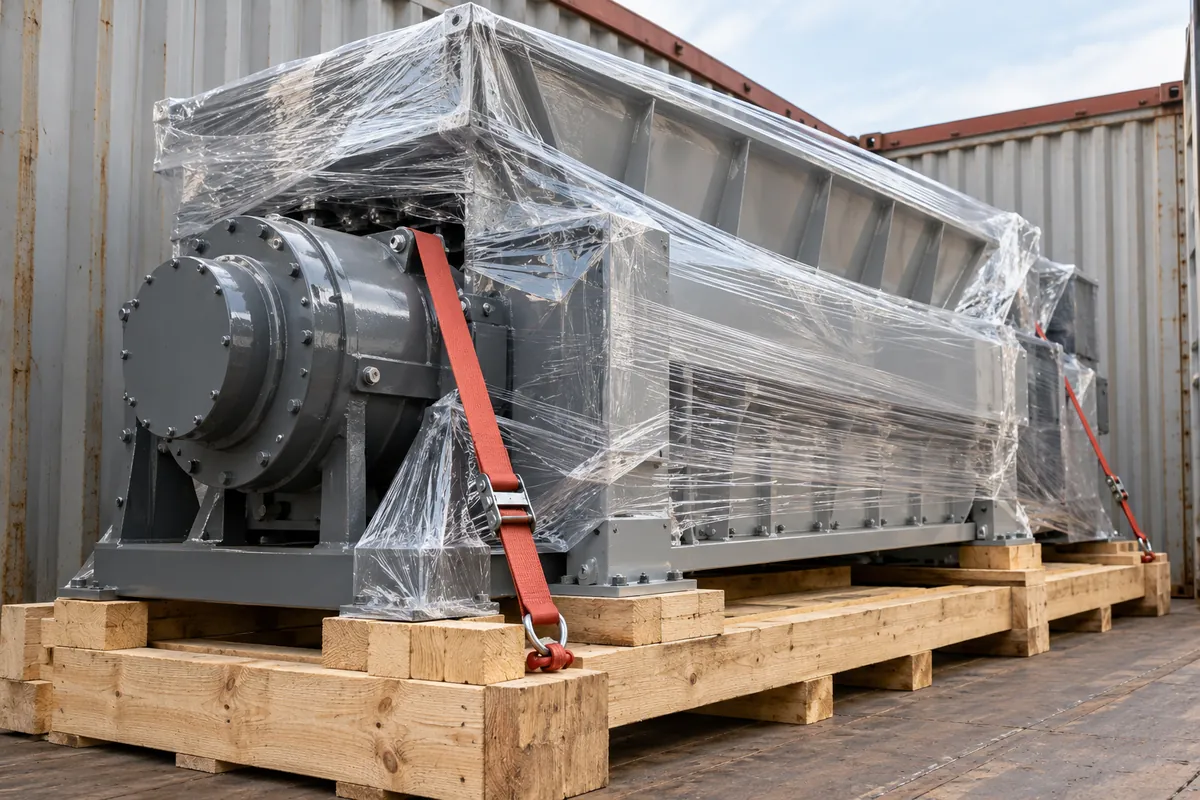
- Wood packaging: skids and crates should use wood treated to the international ISPM 15 standard.
In practice, these documents are usually prepared by the manufacturer or its export partner. Emil Foreign Trade, which handles exports of recycling machinery built in Gaziantep, lists EXW, FCA, FOB, CFR, CIF and DAP among the terms it works with on its page outlining delivery terms and export paperwork for machine buyers.
Installation, commissioning and warranty: put it in the contract
Incoterms govern the process up to delivery; what happens next is a matter for the contract. When buying a recycling line or a cutting machine, agree the following in writing:
- Who is responsible for installation and commissioning, and who pays the technician's travel and accommodation?
- Does the warranty start on the shipment date or on the commissioning date?
- Are operator training, initial spare parts and consumables (such as a spare blade set) included in the offer?
- Are site preparations such as power supply, foundations and line layout the buyer's responsibility?
Conclusion
The right Incoterms rule for a machinery import depends on the buyer's logistics capabilities and where it wants to take on risk. Buyers with their own forwarder and insurance gain more control with FCA or FOB, while DAP is a practical choice for those who prefer a single point of responsibility. With CIF, remember that risk passes at the port of loading and that the insurance is only minimum cover. Whichever rule you choose, spelling out the named place, the version and the installation terms in the contract will help prevent disputes later.